
Last Updated: November 5, 2026
Quick Summary
Eco-friendly packaging for beauty products is packaging designed to reduce environmental impact across its full lifecycle, from raw material sourcing through disposal, covering material choice, weight, recyclability, refillability, and end-of-life. It is not a single material but a set of trade-offs, since glass recycles repeatedly but is heavy to ship while recycled plastic cuts virgin material use but is rarely recyclable again curbside.
- Glass can be recycled repeatedly without losing quality and is chemically inert for formula compatibility.
- Bio-based plastics usually need industrial composting and will not decompose in a home bin.
- Refill systems keep the outer shell and replace only an inner pod or cartridge.
- Recyclability depends on what your local collection system accepts, which varies by municipality.
- Start by switching the outer carton to FSC-certified paper and water-based inks.
Table of Contents
- What Eco-Friendly Packaging for Beauty Products Actually Means
- The Best Eco-Friendly Packaging for Beauty Products by Material
- Sustainable Skincare Packaging: Refills, Airless Bottles, and Dispensing Pumps
- Compatibility, Safety, and Shelf Life: What the Packaging Must Protect
- End-of-Life Instructions by Material and Component
- Eco-Friendly Cosmetic Packaging Wholesale: Costs, MOQs, and Implementation
- Cosmetic Sample Packaging and Subscriptions Without the Waste
- Regulations, Green Claims, and the Lifecycle Trade-Offs Behind Them
- Frequently Asked Questions
What Eco-Friendly Packaging for Beauty Products Actually Means
Eco-friendly packaging for beauty products is packaging designed to reduce environmental impact across its full lifecycle, from raw material sourcing through disposal.
The uncomfortable truth most guides skip: eco-friendly packaging is not a single material but a set of trade-offs. Glass can be recycled repeatedly but is heavier to ship than many alternatives.
At Lauren Lux Beauty™, our signature packaging is designed to be worth keeping.
Below, we break down each material and the general considerations brands face around packaging choices.
The Best Eco-Friendly Packaging for Beauty Products by Material
The most suitable packaging for beauty products depends on what the formula needs. Four material families dominate: glass, post-consumer recycled plastic, bio-based plastic, and paper or molded fiber. Each solves a different problem.
| Material | Best For | Main Strength | Main Trade-Off |
|---|---|---|---|
| Glass | Serums, creams, glosses | Infinitely recyclable, premium feel | Heavy, fragile, higher shipping emissions |
| Post-consumer recycled plastic | Bottles, tubes, compacts | Lower virgin material use, lightweight | Limited recyclability, color variation |
| Bio-based plastic | Airless bottles, pumps | Plant-derived feedstock | Needs industrial composting to break down |
| Paper and molded fiber | Cartons, inserts, sample cards | Recyclable, lightweight, low cost | Poor barrier against liquids and oils |
Glass Containers: Weight, Recyclability, and Formula Compatibility
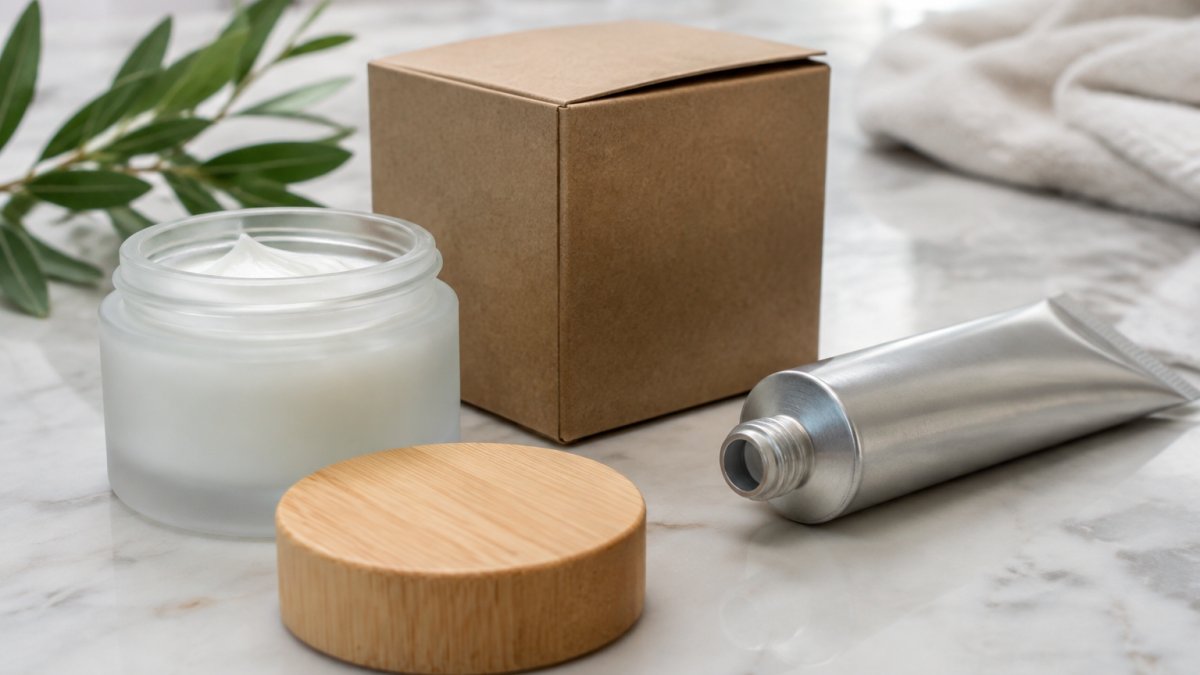
Glass is the strongest recyclability story in beauty packaging because it can be recycled repeatedly without losing quality. It is also chemically inert, so it will not react with a gloss, serum, or cream the way some plastics can. That matters for formula compatibility and shelf life.
The cost is weight: glass raises shipping emissions per unit, and freight charges scale with weight. Fragility adds breakage losses, so for a small-batch brand shipping direct, that math has to be part of the decision.
Post-Consumer Recycled Plastic and Bio-Based Alternatives
Post-consumer recycled plastic, usually called PCR, is plastic reclaimed from consumer waste streams and reprocessed into new packaging.
Expect color variation between batches, since the feedstock varies. Bio-based plastics offer a renewable feedstock, but most need industrial composting conditions and will not decompose in a home bin. Do not call them biodegradable in consumer copy unless you can prove the specific claim.
Paper, Cardboard, and Plastic-Free Options
Paper and cardboard work best where they do not touch a wet formula: outer cartons, inserts, shipping boxes, and sample cards.
Molded pulp and bamboo suit compacts and outer shells. Where a liquid or oil touches the package, paper needs a barrier coating, and that coating is often plastic, so a "plastic-free" claim on a coated carton is worth checking before you print it.
Sustainable Skincare Packaging: Refills, Airless Bottles, and Dispensing Pumps
Sustainable skincare packaging works best when the package is designed to be reused, not just recycled. Refill systems and airless bottles both extend the life of the outer component, which is where most of the material and cost sits.
Refillable packaging keeps the outer shell and replaces only an inner pod or cartridge. The environmental gain depends on how often refills are used.
They are also harder to recycle because they contain mixed materials and a metal spring, so design for disassembly.
- Confirm the refill is priced lower than the full pack
- Check the pump separates from the bottle without tools
- Verify the airless mechanism is compatible with your formula viscosity
Compatibility, Safety, and Shelf Life: What the Packaging Must Protect
The first job of any beauty package is to protect the formula.
Compatibility testing checks whether the formula reacts with the container, liner, or pump. Oils and solvents can leach compounds from certain plastics; fragrance and volatile ingredients can migrate through some materials.
Watch out: choosing a material for its sustainability story before confirming formula compatibility is the most expensive mistake in packaging. A failed stability test after a full order means scrapping the entire run.
End-of-Life Instructions by Material and Component
End-of-life instructions are the part of the package the customer reads last and remembers least, yet they determine whether your recyclability claim is true in practice.
Give component-level guidance, because most beauty packages contain several materials that need different disposal routes. The table below is a starting template, not a universal answer. Verify each row against the collection rules in your primary markets before you print it.
| Component | Typical Material | Practical Disposal Guidance |
|---|---|---|
| Glass jar or bottle | Glass | Rinse to remove residue, remove the lid, recycle curbside where glass is accepted |
| Pump or dropper | Mixed plastic and metal spring | Separate from the bottle if it detaches without tools; check local rules, as many programs reject small mixed components |
| Tube | Plastic with an internal barrier layer | Usually landfill; some programs accept tubes, many do not |
| Outer carton | Cardboard | Flatten and recycle with paper |
| Sample card | Coated or laminated paper | Check whether the coating is plastic; if laminated, it usually goes to landfill |
| Label | Paper or plastic film | Paper labels can stay on glass and paper; plastic film labels often need removal |
How to Separate Pumps, Caps, and Labels
The mechanism matters more than the material name. A pump typically contains a plastic housing, a metal spring, and sometimes a glass or steel ball, bonded or press-fitted together.
Labels are the quiet contaminant. A paper label on a glass jar is usually fine because it burns off in the glass melt. A plastic film label on a plastic bottle can interfere with sorting and with the quality of the recycled flake.
Why Local Collection Systems Decide the Claim
Brands commonly print "recyclable" based on what the material can theoretically become, not on what the customer's bin will accept.
Watch out: a "plastic-free" claim on a coated carton or a "recyclable" claim on a tube with a barrier layer can both be accurate about one component and misleading about the whole package. Check the full assembly, not the headline material, before any disposal instruction goes on the pack.
A Customer-Facing Instruction Template
Keep the on-pack instruction to three lines and put the detail on a QR-linked page. For product care and support questions, we're here to help. A workable pattern is: (1) name the component, (2) name the action, (3) name the destination. For example: "Glass jar: rinse, recycle curbside. Pump: remove, general waste. Carton: flatten, recycle with paper."
Eco-Friendly Cosmetic Packaging Wholesale: Costs, MOQs, and Implementation
Recycled and refillable formats often carry higher MOQs than standard stock packaging, because suppliers need volume to justify a run, and custom tooling for a refill pod or disassemblable pump can push the minimum higher still. The practical question is not "what does sustainable packaging cost" but "which cost drivers can I control at my volume."
What Actually Drives the Quote
Pricing depends on quantity, dates, and delivery; visit the Lauren Lux Beauty™ website for current prices or a quote.
- Material: PCR and bio-based resins usually cost more than virgin plastic, and cosmetic-grade PCR commands a premium because supply is constrained.
- MOQ: custom tooling, colors, and decoration each raise the minimum, and refill formats often require two production runs, one for the outer and one for the pod.
- Decoration: water-based inks and uncoated stock limit some finishes, and some suppliers charge a setup fee per color.
- Freight: heavier materials raise shipping cost per unit, and glass is the clearest example because freight scales with weight.
- Testing: compatibility and stability testing add cost before production, and skipping it is the most expensive shortcut in the category.
Supplier Questions Worth Asking Before You Commit
Brands commonly compare unit price and stop there. Ask instead: What is the recycled content by weight, and can you document it? Can the pump be separated from the bottle without tools? What is the MOQ for the refill pod versus the full pack? Which components are mono-material, and which are bonded? What testing do you recommend for our formula, and who runs it? Can you supply packaging weight per unit so we can track reduction over time?
A Phased Transition Plan
Start with one product line, prove the refill or recycled format works commercially, then scale. A workable sequence: first, switch the outer carton to FSC-certified paper and water-based inks, low-risk and low-cost; second, move one high-volume bottle or jar to PCR and confirm compatibility; third, pilot a refill or disassemblable pump on a single SKU and measure refill uptake; fourth, extend the proven format to adjacent products.
Measurable Sustainability KPIs
Track a small set of numbers so progress is visible rather than asserted. Recycled content as a percentage of total packaging weight, packaging weight per unit, refill rate as a share of repeat purchases, and packaging recovery rate where you can measure it are practical starting metrics. If you want to see how we package our own products, you can shop the Maison for lashes and glosses in packaging designed to be kept.
Cosmetic Sample Packaging and Subscriptions Without the Waste
Cosmetic sample packaging is the hardest format to make sustainable, because samples are small, single-use, and often over-packaged. The fix is to remove layers, not add eco-labels.
If you want more beauty guidance and product inspiration, our beauty notes from the Maison cover soft glam tips and lash guides.
Regulations, Green Claims, and the Lifecycle Trade-Offs Behind Them
A lifecycle assessment looks at impact across sourcing, production, transport, use, and disposal (RMIS).
For quick answers about our products, shipping, and returns, our frequently asked section covers the details. If you want to know the values behind the products, read the House of Lauren Lux Beauty™ story.
Choosing packaging that is genuinely better, not just better labeled, comes down to matching material to formula, designing for reuse, and telling the truth about disposal.
Frequently Asked Questions
What is the most eco-friendly packaging for beauty products?
There is no single winner. Glass is endlessly recyclable and protects formulas well, but it is heavy and raises transport emissions. Post-consumer recycled plastic is lighter and uses existing waste streams. Refillable systems cut material use over time, provided the refill actually gets used. The right choice depends on the formula, the shelf life it needs, and how your local recycling infrastructure handles each material. Choose based on the full lifecycle, not one label on the box.
Is glass or recycled plastic better for skincare packaging?
It depends on what the formula needs. Glass is inert, so it will not react with acids or fragrance, and it can be recycled repeatedly. It is also heavier, which adds carbon footprint during shipping. Post-consumer recycled plastic is lighter and increasingly available, but some formulas need a barrier layer to prevent oxygen ingress. For water-based skincare with a short shelf life, recycled plastic often wins on lifecycle; for oils and actives, glass frequently does.
Can cosmetic packaging actually be recycled at home?
Often only partly. Rigid glass jars and bottles are widely accepted. Cardboard outer boxes are usually recyclable. The hard parts are mixed-material components: pumps with metal springs, airless bottles with internal mechanisms, and multi-layer tubes. Check your local council rules, and separate components where you can. Brands that publish end-of-life instructions by component make this far easier, which is a reasonable thing to look for when buying.
How can small beauty brands find sustainable packaging suppliers?
Start with suppliers who publish material specifications, recycled content percentages, and certifications such as FSC for paper. Ask for minimum order quantities early, because eco-friendly cosmetic packaging wholesale often carries higher MOQs than standard stock. Request samples to test formula compatibility before committing, and ask whether refill or take-back schemes are supported. Costs and MOQs vary widely by material and order size, so request quotes rather than assuming a figure.
